
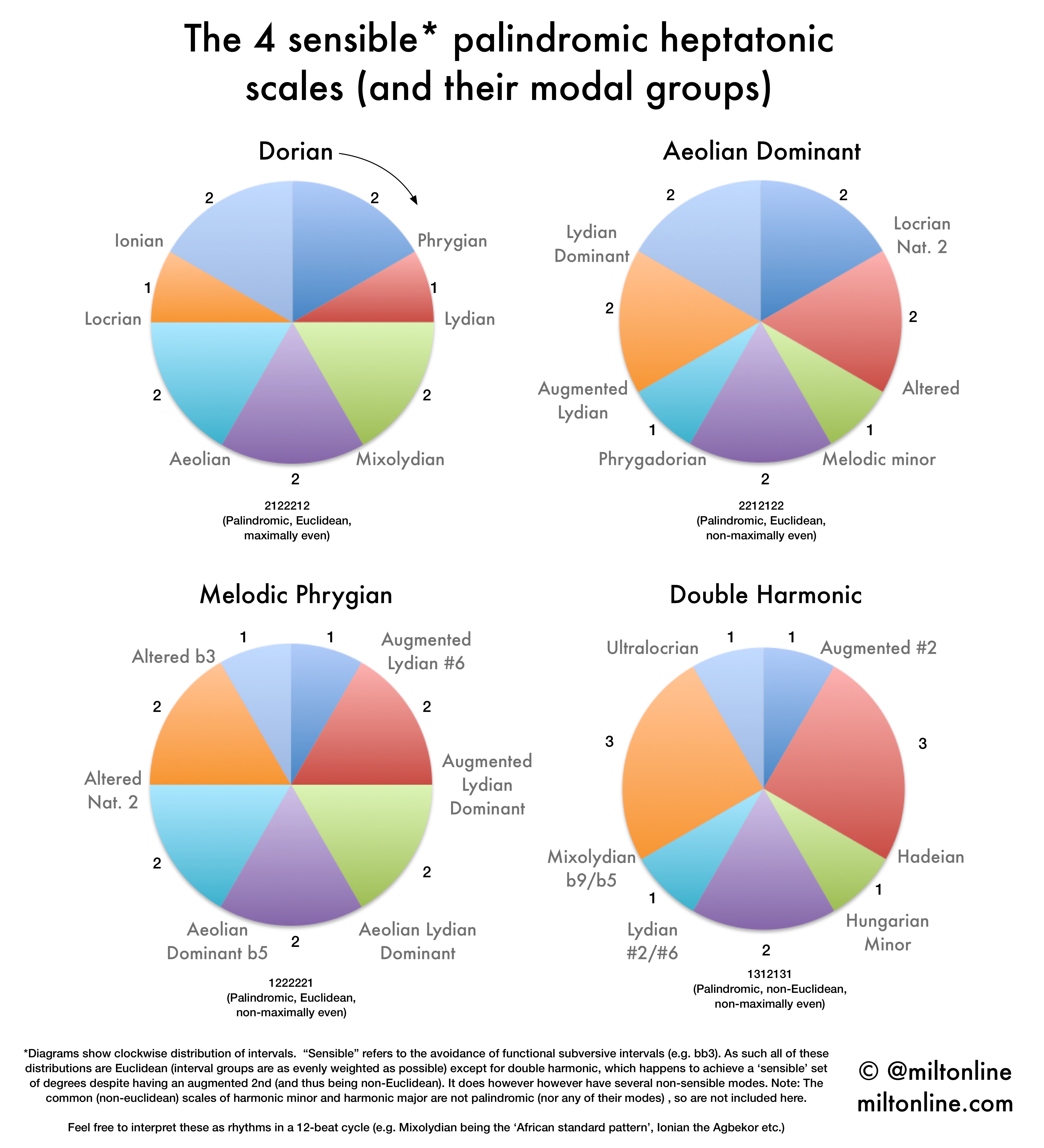
I’ve had this insight about palindromic scales, modes, modal groups, and the Euclidean (and sometimes maximally even) distributions of 7 notes in a one octave scale. This is what it looks like in my head. I really like that the ‘central’ scale of a group is not the traditional figurehead (Ionian, melodic minor etc.) but the palindromic parent. Nice to see the patterns emerge diagrammatically, and I will aim to use Melodic Phrygian and its modes in composing/improvising!
(Visited 959 times, 1 visits today)

2 replies on “Palindromic scales and their modal groups”
What is a “Melodic Phrygian”? I can’t find anything about this online.
What are the parameters of this scale?
Thank you, Tim Bloch
Neapolitan major r b2 b3 4 5 6 7 r
Aeolian is r 2 b3 4 5 b6 b7 r
phrygian is r b2 b3 4 5 b6 b7 r
Melodic minor is r 2 b3 4 5 6 7 r
So melodic minor is natural 6 and 7 with a b3 of minor.
Think of melodic phrygian as phrygian with a natural 6 and 7 like melodic minor but with a phrygian b2 and b3